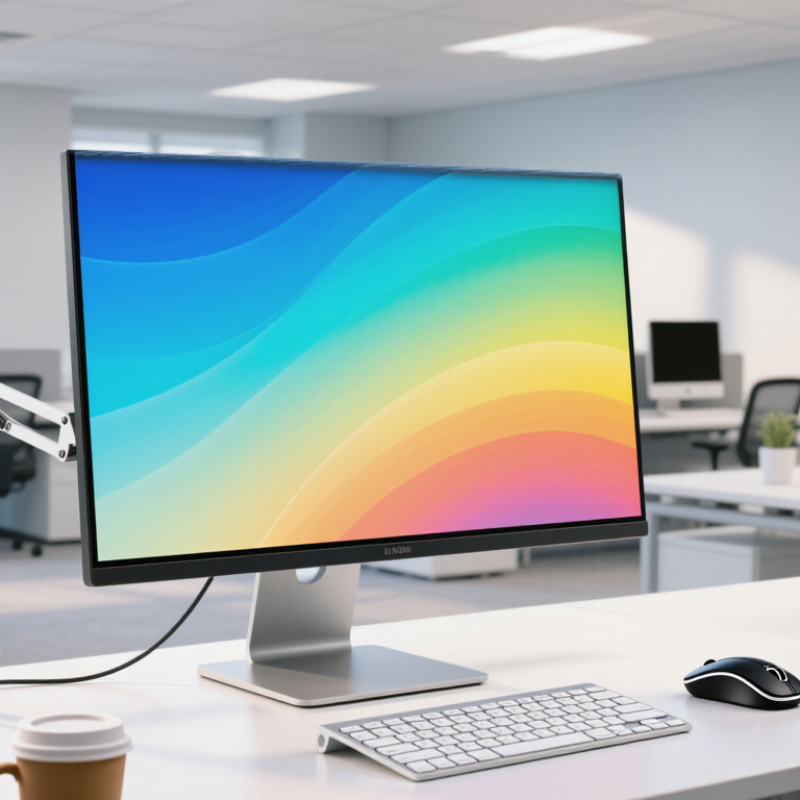
How to Choose the Best LCD Monitor for Business?

Choosing the right Lcd Monitor is a business decision, not merely a search for the lowest price. Employees may stare at the screen for eight hours, while finance teams compare figures under ordinary office lighting. A poor choice can create glare, eye fatigue, cluttered desks, and unnecessary replacement costs.

Industry evidence supports a more disciplined approach. IDC’s Worldwide Quarterly PC Monitor Tracker shows that monitor demand remains closely tied to office upgrades, hybrid work, and productivity requirements. Meanwhile, the U.S. Environmental Protection Agency reports that ENERGY STAR certified monitors are generally more energy-efficient than conventional models. Energy savings matter across hundreds of workstations. They also affect heat, maintenance, and long-term operating budgets.

DisplayMate president Raymond M. Soneira has written, “The display is the most important component in a smartphone.” The principle also applies to office screens. Image quality is the daily interface between employees and their work. Yet specifications can mislead. A higher refresh rate may matter to designers, but not to an accountant reviewing spreadsheets. A 4K panel may reveal fine detail, while scaling problems can reduce practical comfort. That contradiction deserves attention.

This guide examines panel type, size, resolution, ergonomics, connectivity, color accuracy, energy use, warranty support, and total cost of ownership. It also questions popular assumptions. Bigger is not always better. Cheaper is not always efficient. The best Lcd Monitor is the one that fits real workflows, real desks, and real people.

How to Choose the Best LCD Monitor for Business?

Define Business Monitor Requirements and Workspace Priorities

Start with work, not specifications. A spreadsheet-heavy role may need a 27-inch LCD monitor with sharp text and generous horizontal space. Designers may prioritize accurate color, while customer-service teams often need clear viewing angles. Ask employees what they read, compare, and create each day. Their answers are more useful than a generic office checklist.

Workspace conditions matter just as much. Measure the desk depth, viewing distance, and available power outlets. A large monitor can overwhelm a narrow desk and force uncomfortable head movement. Check whether the stand supports height, tilt, and rotation adjustments. These details reduce neck strain during long sessions. In one shared office, we chose screens that were easy to adjust, but the stands occupied too much desk space. That mistake was avoidable.

Lighting also shapes the decision. A matte surface can reduce reflections near windows, while suitable brightness helps in dim rooms. Consider connection types, docking needs, warranty coverage, and repair support before approving a purchase. Security and privacy may matter in reception areas or open-plan offices. Do not assume every employee needs the same display. A lower-cost monitor may serve email work well, but it can slow detailed analysis. Test shortlisted models with real documents, small fonts, and video calls. Review the setup after two weeks. Workers may reveal problems that specifications never show.

Compare Panel Types, Screen Sizes, and Resolution Options

Choosing an LCD monitor for business starts with the work performed each day.

Panel type affects comfort, color, and viewing consistency. IPS panels usually provide accurate colors and wide viewing angles. They suit design reviews, shared spreadsheets, and client presentations. VA panels often deliver deeper contrast, which helps with charts and dark images. TN panels can respond quickly and cost less, but their viewing angles and color quality may disappoint. I would test text at normal working distance, not only inspect a specification sheet. Small differences become obvious after several hours.

Screen size should match desk depth and software habits.

A 24-inch display fits compact workstations and basic office tasks. A 27-inch screen gives documents more breathing room without feeling excessive. Larger screens help analysts compare windows, although they can encourage awkward head movement. Measure the desk before ordering. A 4K display makes fine text and detailed tables look sharp, but scaling may be necessary on smaller screens. Full HD remains practical for routine email and web applications. QHD sits between them and often balances workspace, clarity, and cost.

Resolution alone is not enough.

Check pixel density, operating-system scaling, refresh rate, and connection compatibility. A bright screen may look impressive in a showroom yet feel tiring beside a window. Matte coatings reduce reflections, though some can soften text slightly. I once favored maximum resolution and underestimated scaling issues. That choice created cramped menus.

Real work exposed the mistake. Compare sample documents, not promotional images. Also consider height adjustment and blue-light controls, because posture and eye comfort affect productivity every afternoon.

Evaluate Ergonomics, Connectivity, and Multi-Monitor Support

How to Choose the Best LCD Monitor for Business?

A business monitor should support comfortable work through long, ordinary days. Look for height adjustment, tilt, swivel, and a stable stand. Your eyes should meet the upper third of the screen. This reduces neck strain during document editing and video meetings. A matte surface can also control reflections near windows. I once underestimated desk depth, and the monitor sat too close. That mistake made extended reading uncomfortable.

Connectivity affects daily efficiency. Choose ports that match your computer, docking station, and meeting equipment. USB-C can carry video, data, and power through one cable, but check its actual wattage. A built-in hub may reduce desk clutter. Multiple monitors need more than attractive specifications. Confirm your computer supports the required resolution and refresh rate. Test the arrangement before buying several displays. Tiny mismatches can become irritating.

Tips: Measure your desk first. Check every port. Set the main screen directly ahead. Keep side monitors angled slightly inward. Use identical sizes when possible, although mixed screens can work. Consider a monitor arm if the supplied stand lacks flexibility. Do not trust every advertised feature. Read technical manuals and independent test results, then compare warranty terms and service access. A lower price may become expensive when adjustment, compatibility, or reliability is poor.

How to Choose the Best LCD Monitor for Business? - Evaluate Ergonomics, Connectivity, and Multi-Monitor Support

Evaluation Area Specification or Metric Recommended Business Target Why It Matters What to Check Before Purchase
Ergonomics Height adjustment Allows users of different heights to position the top of the screen near eye level, reducing neck and shoulder strain. Confirm that the adjustment range is stated in the technical specifications.
Ergonomics Tilt and swivel Helps users align the display with their seating position and reduce glare caused by overhead lighting. Look for a stand with both tilt and swivel functions rather than tilt-only adjustment.
Ergonomics Pivot rotation Useful for reading documents, coding, reviewing long web pages, and working with narrow data columns. Verify that portrait mode is supported by the stand and operating system.
Ergonomics VESA mounting Supports monitor arms, wall mounts, and multi-screen workstation layouts. Check both the VESA pattern and the monitor weight without its stand.
Ergonomics Screen size and resolution Provides practical text clarity and workspace without requiring excessive desk depth or display scaling. Match resolution to viewing distance, graphics workload, and the computer's graphics output.
Ergonomics Brightness and anti-glare surface Maintains readable text in typical office lighting while limiting distracting reflections. Consider a higher brightness range only for bright rooms; excessive brightness can increase eye discomfort.
Ergonomics Flicker control and low-blue-light mode Can improve viewing comfort during long work sessions, although it does not replace regular breaks and proper lighting. Check whether the mode can be enabled without making text visibly distorted or overly warm.
Connectivity DisplayPort input Provides broad compatibility with business computers and supports digital video and audio transmission. Confirm the supported resolution and refresh rate for the intended computer.
Connectivity HDMI input Useful for laptops, small-form-factor computers, docking devices, and meeting-room equipment. Do not assume every HDMI port supports the monitor's maximum resolution and refresh rate.
Connectivity USB-C video connection Can carry video through a single cable from compatible laptops and reduce desktop cable clutter. A standard USB-C connector alone does not guarantee video output; verify DisplayPort Alternate Mode support.
Connectivity USB-C power delivery Allows one cable to transmit video, charge a compatible laptop, and simplify hot-desking. Compare the monitor's power-delivery rating with the laptop's required wattage.
Connectivity USB hub Provides convenient access for keyboards, mice, headsets, storage devices, and other desk accessories. Check whether the hub requires an upstream USB connection and whether fast charging is supported.
Connectivity Audio output Supports headsets, video meetings, and basic audio without routing cables directly to the computer. Integrated speakers are convenient but may not replace a dedicated conference-room audio system.
Multi-Monitor Support DisplayPort daisy chaining Can reduce cable clutter by linking compatible monitors in sequence. MST support must be available on the computer, graphics hardware, and monitor; macOS support may differ by configuration.
Multi-Monitor Support Output DisplayPort Enables the video signal to pass from one compatible monitor to the next. A DisplayPort input alone is not sufficient; look specifically for DisplayPort-out or MST terminology.
Multi-Monitor Support Bezel width Creates a smaller visual gap between screens and improves the continuity of multi-monitor workflows. Compare the actual bezel dimensions, not only marketing terms such as “frameless.”
Multi-Monitor Support Screen alignment Reduces cursor movement inconsistencies and makes documents, spreadsheets, and dashboards easier to manage. Use identical specifications where possible, or confirm that operating-system scaling can compensate.
Multi-Monitor Support Graphics output capacity The monitor cannot compensate for limitations in the computer's graphics processor, ports, or docking station. Confirm the maximum supported displays, resolution, refresh rate, and connector type in the computer documentation.
Business Practicality Refresh rate Standard office applications, documents, email, and web tools generally do not require gaming-oriented refresh rates. Prioritize ergonomic adjustment, text clarity, and connectivity before paying for a higher refresh rate.
Business Practicality Warranty and serviceability Reduces downtime and simplifies replacement planning for office fleets. Review exclusions, return procedures, support response times, and availability of replacement units.

Assess Image Quality, Eye Comfort, and Energy Efficiency

When choosing an LCD monitor for business, image quality should support long working hours, not merely look impressive in a showroom. A 2018 review in BMJ Open Ophthalmology reported that digital eye strain may affect up to 90% of screen users. Check text sharpness, stable backlighting, and natural contrast at normal office distance. A 24-to-27-inch screen with adjustable brightness often works well for documents and spreadsheets. Avoid excessive brightness.

Eye comfort depends on setup too. Look for flicker-reduced operation, a matte surface, and height adjustment. Position the screen about 50–70 centimeters from your eyes, with its top edge near eye level.

The 20-20-20 rule remains practical: every 20 minutes, view something 20 feet away for 20 seconds. It is not a perfect medical solution.

Some users still experience dryness or headaches, so personal testing matters.

Energy efficiency deserves equal attention. The International Energy Agency’s Energy Efficiency 2023 report states that buildings consume about 30% of global final energy. A monitor uses less energy than major office equipment, but thousands of displays create a measurable load.

Compare active, sleep, and standby wattage rather than relying only on an efficiency label. European electronic-display rules also set limits for power consumption and standby behavior.

Higher refresh rates can increase power use. That trade-off is easy to overlook.

Select the Best Monitor Based on Budget, Warranty, and Value

Choosing the best LCD monitor for business starts with total cost, not the lowest shelf price. Set a realistic budget, then compare brightness, resolution, connectivity, and expected daily use. A sharp 27-inch display may reduce eye strain during long spreadsheet sessions, but an expensive panel is wasteful for simple reception work. Look beyond the sticker. The U.S. Environmental Protection Agency reports that certified monitors use about 25% less energy than conventional models, helping reduce electricity costs across a large office.

Warranty deserves equal attention. Check its length, dead-pixel policy, repair process, and whether shipping costs are covered. A three-year warranty can protect productivity better than a slightly cheaper model with limited support. I have seen buyers ignore this detail. That assumption fails when one unavailable screen delays a workstation for several days. Request the warranty terms in writing, especially for shared offices and purchasing contracts.

Value also includes serviceability and lifespan. The Global E-waste Monitor 2024 reported 62 million tonnes of electronic waste in 2022, while only 22.3% was formally collected and recycled. A monitor with replaceable components, efficient power use, and a longer support period may create less waste and fewer replacement costs. I still sometimes overvalue higher resolution. For business, stable performance and dependable support can matter more than impressive specifications. Compare the five-year cost, not just today’s invoice.

Search our website